Showing posts with label face masks. Show all posts

Thursday, 6 August 2020

Face masks made of smart Eco fibres for comfort and style.

The latest must-have fashion accessory is no longer the “It” bag or the latest designer trainer.
It’s the face mask which we are now required to wear in most public places in order to help stop the spread of the Coronavirus.

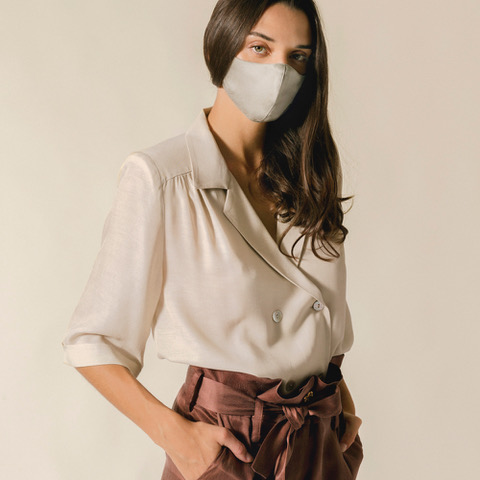
So why not look good and feel free and safe when wearing one that is made totally from a silk-like Cupro, the name commonly used for fibres by Bemberg™ by Asahi Kasei. 


The new PNLP (Penelope) face mask is made in an eco and sustainable material that comes from the smart-tech transformation of cotton linter pre-consumer materials and converted through a traceable and transparent closed loop process.


Now these masks are ready to hit the market with their unique features that combine sustainability with a lovely fabric that is soft and smooth as silk and feels like a second skin.
Made in Italy, the Cupro’s Collection is also biodegradable and available online, in adult as well as child sizes.


Other textiles companies who have joined in and converted their production units to making masks as well as medical gowns include Cifra, Illuna Group, Rosti and Sitip, who have collaborated with ROICA™, the premium stretch fibre by Asahi Kasei. ROICA™ is the innovative and smart premium ingredient chosen by these companies to give comfort to the wearer, thanks to an exceptional top-level component that gives elasticity for perfect adherence to the skin.
Illuna Group Lace Mask.

Cifra presents the eco-sustainable version of the mask, the ECO-MASK™, which combines the high performance of Cifra's knitting technology with the sustainability of the materials used. The 100% regenerated yarns create a 100% sustainable mask with 83% ECONYL and 17% ROICA™ V550 elastomer, the stretch fiber certified with Cradle to Cradle Gold Health Level which allows excellent and lasting printability, as well as advantages regarding the circular economy as it does not release harmful substances into the test environment according to the Hohenstein Environmental Compatibility certification.

Wednesday, 10 June 2020

Face masks by six British designers for charity

Following the British government’s announcement that it will be mandatory to wear face coverings on public transport in England from June 15, to help limit the spread of the coronavirus, the British Fashion Council has announced that British fashion designers and brands including Raeburn, Mulberry and Liam Hodges, have collaborated with the British Fashion Council on their "Great British Designer Face Coverings: Reusable, for People and Planet" campaign to raise money for charity.
Photo from British Fashion Council.

There are six sustainable, non-medical face masks, designed by Halpern, Julien Macdonald, Liam Hodges, Mulberry, Raeburn and Rixo, which the British Fashion Council hopes will raise £1 million to be split between three different charities: NHS Charities Together Covid-19 Urgent Appeal, Wings of Hope Children’s Charity, and the BFC Foundation Fashion Fund, which will support the next round of funding to give back to British designer businesses.

The campaign is launched in collaboration with ethical supply chain specialists Bags of Ethics, which has manufactured the face coverings in its partner factories. The re-usable face mask are sold in packs of three with two protective pouches for £15. They are made of fabric and contain no single-use plastic.

These non-medical face coverings are available to buy online through britishfashioncouncil.com and through partner retailers soon including Asos, Boots, John Lewis and Partners and Sainsbury’s in Tu Clothing sections in selected superstores, convenience stores and online at Tu.co.uk and Argos.co.uk.
The launch of these designer face masks coincided with London Fashion Week which was staged for the first time as a “digital” event, rather than the habitual three-day schedule of physical catwalk shows, glamorous presentations and events that fashion editors, international buyers and influencers have become accustomed to.  Due to the health and safety concerns impacted by the Covid-19 pandemic, this quarantine-friendly digital format featured a dedicated online platform with a timed schedule of content-based "events" - from fashion films and digital showrooms to podcasts, playlists and panel discussions. Also instead of a menswear-focused show, the June 2020 event was a gender neutral affair, covering both menswear and womenswear designers and for the first time, members of the general public were able to watch for free the fashion content.

Encouraging signs Britons ready to return to the high street, says new report.

As of June 15th,  non-essential shops and retailers will be allowed to reopen in England.  But will consumers be happy or feel safe to return to the high street?  During the lockdown months due to the Covid-19 outbreak, consumers (my household included) have been embracing online purchases as never before. Many in the business and retail sectors predict that the high street will not be the same as before the lockdown.  At least the public will be seen wearing face coverings, as advised by the UK government, especially in enclosed public spaces where you may be more likely to come into contact with people you do not normally meet.  

Based on the latest scientific evidence from the Scientific Advisory Group for Emergencies (SAGE), the government confirmed face coverings can help reduce the risk of transmission in some circumstances.  However face coverings are not a replacement for social distancing and regular handwashing which remain the most important actions, says Chief Medical Officer.

The public is to wear face coverings in enclosed public spaces such as shops, trains, buses and all public transports to help reduce the spread of coronavirus, says UK government. 
Mask shown above is from FFSB, created in support of the #Masks4all movement, with 10% of profits from the sales of the masks goes to Young Minds Charity.  The collection comes in eight different designs, packaged in pairs and available in adult and kid sizes.  Mentored by the London fashion company House of Baukjen, FFSB produces up-cycled masks in an ethical and family-run factory in Portugal. All masks are handmade in a double layered, pleated design using 100% soft cotton leftover fabrics and cut-offs and can be worn time and time again. FFSB was launched by four Britons: Frank, Finn, Sebastian and Bela. With their GCSE’s cancelled amidst the pandemic, the students chose to use their exam time to make a difference, take action and show that young people can do something meaningful in these unprecedented times. 

Now new research commissioned by People 1st International provides encouraging signs that Britons are ready to return if the correct measures for health and safety are in place. The findings also highlight that the younger generation will be a driving force when it comes to kick-starting the visitor economy.

Two thousand people aged 18 and above took part in the research, which focuses on the behavioural attitudes and factors impacting a return to leisure activities such as pubs and bars, restaurants, holidays, non-food shopping and visiting local attractions, according to the report published in early June.  (The research was based on an online survey of 2079 people from across the UK carried out by Populus in the third week of May 2020.)

Asked about what would influence their decision to take part in these activities, more than half of respondents cited the importance of the following five factors:

• Crowd levels (69%)
• Ability to social distance (64%)
• Confidence in infection control measures (63%)
• Cleanliness and hygiene (61%)
• Confidence that staff have been trained in these new measures (54%)

Whilst both men and women consider these factors important, women appear to be more cautious. For example, 73% of women are concerned about how crowded a location might be, 66% (women) are concerned about cleanliness and 60% of women want to be confident that staff have been trained in safety and hygiene.
The younger generation (aged 18-24) appear to be spearheading the return, and are by far the most positive across the board, whether that is spending more time with family and friends (60%) planning to eat out more (34%), visit pubs and bars more (30%) or do more outdoor activities (48%).
“It’s not surprising to see the importance that consumers are placing on health and hygiene when it comes to their plans to return to leisure activities. It’s also really encouraging that young people want to go out and seize the day after lock-down. Hopefully their zest for life will help to kick-start the hard-hit hospitality and tourism sectors,” says Jane Rexworthy, Executive Director of People 1st International.  “Staff training to support health and hygiene beyond Covid-19 that’s in line with government guidance is critical to building consumer confidence, which is why we have developed WorldHost 2020, a new e-learning module to empower staff to keep customers and colleagues safe - helping assure business leaders that they can reopen their doors with confidence.”

Wednesday, 20 May 2020

Hygiene Austria sets up face mask production in English seaport for UK market

Just one month after two Austrian companies – Lenzing and Palmers  - joined forces to form  Hygiene Austria** specifically to produce protective face masks for usage in its own country and distribution to Europe, the company has now announced the setting up of a similar production site in Grimsby, United Kingdom, to supply the urgent needs of the British market.  Grimsby is a large coastal English seaport and administrative centre in North East Lincolnshire, on the South Bank of the Humber Estuary, close to where it reaches the North Sea.


A company spokesman said that since production had started in May in Austria, millions of euros worth of orders had been placed.  The product range includes mouth-nose safety masks, FFP2-masks as well as coloured face masks for children.

According to Tino Wieser, member of the Board of Palmers, the demand in the UK for protective masks is massively driven by the consequent handling of Covid-19.  He said "The supply chain is complex and serving the UK market from Austria is costly.” The managers therefore decided to implement the same approach as in Vienna. “We will pull up our sleeves, start organizing machinery and a well working raw material supply chain and commence producing face masks locally as soon as possible”, Wieser adds.
The Lenzing plant in Grimsby, UK.
UK’s newly appointed International Trade Minister Ranil Jayawardena, said: “Sourcing PPE for our frontline workers is a key priority for our government. Alongside our efforts in international procurement, it is excellent that we have been able to assist companies from overseas to invest in Britain too, leading to domestic production of vital supplies.”

As a production site, the Lenzing facilities in Grimsby were deemed the best option, according to Phil Munson, Operations Director at the Lenzing Grimsby plant.  He said: “We are eager to play a leading role to ensure the primary health care to the UK population as a key supplier teaming up with our National Health Service (NHS). Moreover, we can count on highly experienced service and maintenance personnel here in Grimsby.” He also highlighted that just like in Austria, new jobs will be created in Grimsby as well, in production, order processing, key accounting, supply chain management and logistics.  Masks for both medical personnel as well as regular citizens will be produced at this plant.

With the set-up of Wiener Neudorf in Austria serving as a blue print for the production in Grimsby, the gained experience will allow an even faster and smoother production in the UK.

At the site in Grimsby first production machines are being installed so production can start between end of May / beginning of June with a monthly capacity of 10 million pieces. Pittsburgh (Pennsylvania) based law firm Reed Smith provided legal counsel on the incorporation of the subsidiary.

**
Hygiene Austria LP GmbH was established on April 24th 2020 by Lenzing AG and Palmers Textil AG as a hygiene competence center with the goal of fast and independent production of hygiene items at Palmers’ former production site in Wiener Neudorf, close to Vienna. The company, in which Lenzing AG holds 50.1% and Palmers Textil AG 49.9%, manufactures the so-called mouth-nose-safety masks (MNS)/ surgical masks of class EN14683 with a monthly capacity of 12 million pieces – to be increased to 25 million pieces soon.